
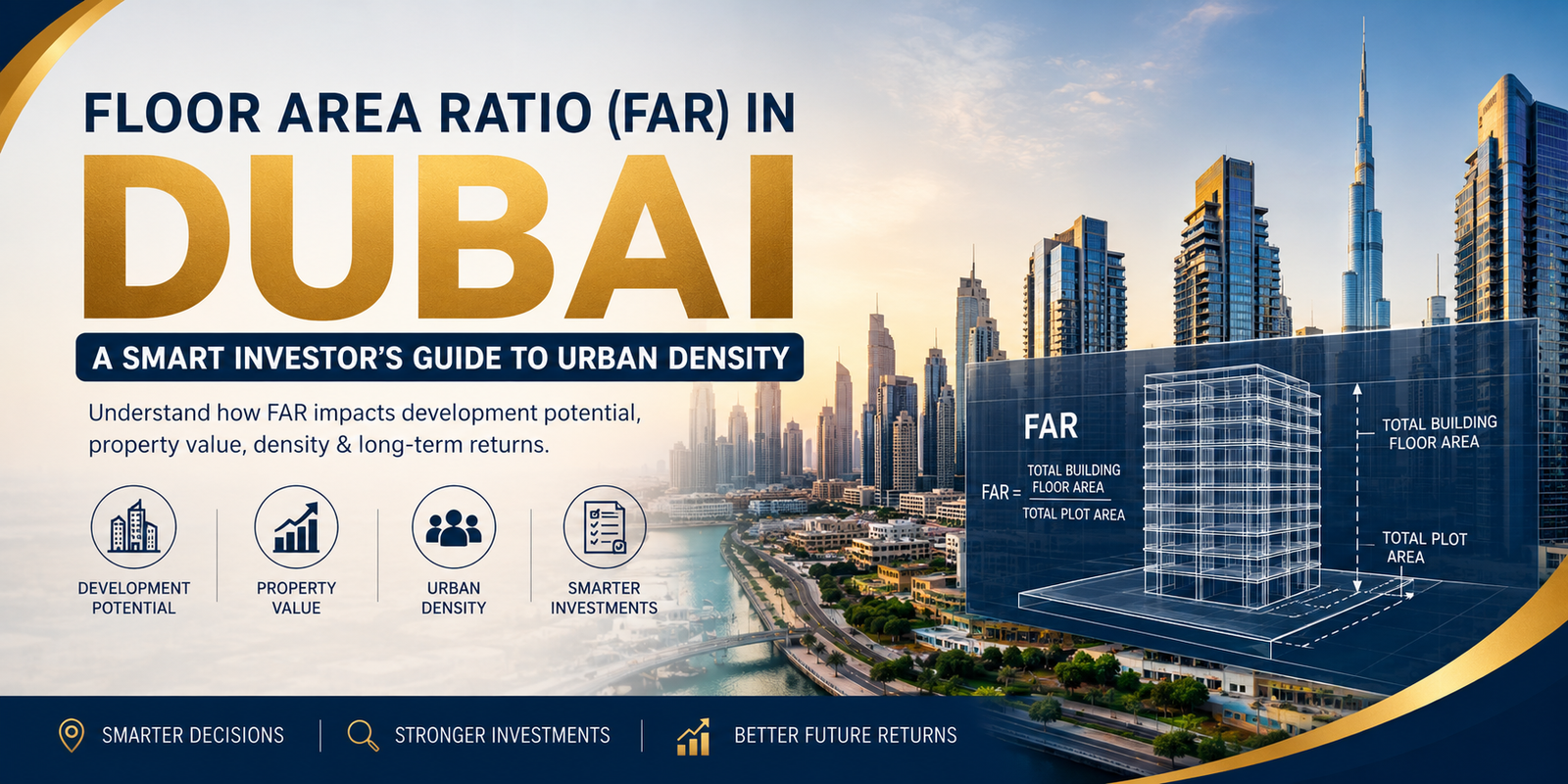
Dubai’s real estate market is driven by innovation, infrastructure, and large-scale urban development. However, beyond luxury towers and premium communities, one important factor shapes every project’s future — Floor Area Ratio (FAR).
For investors, FAR is not just a technical planning term. It directly affects development potential, building density, future supply, community comfort, and long-term property value. Whether purchasing land, investing in off-plan developments, or evaluating commercial opportunities, understanding FAR can help buyers make more informed decisions.
What Is Floor Area Ratio (FAR)?
Floor Area Ratio refers to the relationship between the total permitted built-up floor area and the total land area of a plot.
In simple terms, FAR determines how much construction is legally allowed on a piece of land.
For example, if a plot measures 10,000 sq. ft. and the approved FAR is 5, the developer can build up to 50,000 sq. ft. of total floor space.
FAR plays a major role in shaping Dubai’s skyline because it controls:
- Building density
- Tower height potential
- Community spacing
- Parking requirements
- Infrastructure load
- Open space distribution
Higher FAR generally allows larger developments, while lower FAR helps maintain low-density living and privacy.
FAR vs. GFA: Understanding The Difference
Many buyers confuse FAR with Gross Floor Area (GFA), but both serve different purposes.
Gross Floor Area (GFA)
GFA represents the total constructed area inside a building’s external walls. It may include:
- Residential units
- Commercial areas
- Internal corridors
- Service rooms
- Shared enclosed spaces
While GFA measures the physical size of a building, FAR determines how much floor space can legally be developed on the plot.
Understanding this difference helps investors better evaluate project feasibility and future development potential.
Why FAR Matters In Dubai Real Estate
FAR directly influences property value because it determines development intensity.
A higher FAR can allow:
- More residential units
- Larger commercial spaces
- Higher rental inventory
- Greater revenue potential
Business districts such as Downtown Dubai and Dubai Marina typically support higher FAR due to strong infrastructure and demand for vertical development.
In contrast, villa communities and luxury waterfront areas often maintain lower FAR to preserve exclusivity, privacy, and spacious living environments.
However, higher FAR is not always better.
Investors should also consider:
- Traffic congestion
- Parking availability
- Elevator capacity
- Maintenance costs
- Future tower obstruction risks
- Overall community livability
Balanced density often creates stronger long-term value and end-user appeal.
How To Calculate FAR
The FAR calculation is straightforward.
Divide the total approved building floor area by the total plot area.
Example:
- Plot Area: 10,000 sq. ft.
- Total Approved Floor Area: 50,000 sq. ft.
- FAR = 5.0
Before evaluating FAR, investors should verify:
- Plot dimensions
- Land use permissions
- Height restrictions
- Parking regulations
- Authority approvals
- Setback requirements
Even minor planning restrictions can impact final development capacity.
Typical FAR Trends In Dubai
Different communities in Dubai follow different FAR structures based on urban planning objectives.
High-Rise Districts
Areas like Business Bay and Downtown Dubai generally feature higher FAR to support commercial activity and vertical development.
Mid-Rise Communities
These areas maintain moderate FAR to balance density and comfortable living.
Villa Communities
Villa districts operate with lower FAR to preserve greenery, privacy, and spacious layouts.
Waterfront Developments
Luxury waterfront zones often maintain controlled FAR to protect views and premium positioning.
FAR And Off-Plan Investments
For off-plan investors, FAR becomes extremely important because it influences future community density.
Nearby plots with high FAR permissions may later introduce:
- Additional towers
- Increased traffic
- Reduced views
- Higher population density
- More rental competition
Studying FAR allows buyers to understand the long-term development vision of an area before investing.
Different Planning Authorities In Dubai
Dubai operates through multiple planning authorities, including:
- Dubai Municipality
- Dubai Development Authority (DDA)
- Free Zone Authorities
- Master Developers
Each authority may apply different regulations related to:
- FAR limits
- Height approvals
- Parking standards
- GFA calculations
- Sustainability requirements
Because of these differences, investors should always confirm planning permissions through official documentation.
Key Investor Checks Before Buying
Before purchasing property or land in Dubai, investors should review:
- Approved FAR
- Future neighboring developments
- Parking ratios
- Infrastructure capacity
- Road access
- Community density
- Master plan approvals
- Long-term view protection
These factors help buyers understand the true investment potential of a project.
Conclusion
Floor Area Ratio is one of the most important planning indicators in Dubai real estate. It shapes development scale, density, future supply, investment returns, and overall community quality.
Whether investing in plots, commercial spaces, or off-plan projects, understanding FAR helps investors make smarter and more strategic decisions.
As Dubai continues expanding through infrastructure growth and urban transformation, buyers who understand planning fundamentals like FAR will always hold a stronger advantage in the market.